 Isaac Hess
August 2026
The Championship Program: Movement
Second of six. Mindset came first because without it none of the rest holds. This one is where it becomes real.
Physical mastery builds mental mastery. Movement that challenges the body teaches the mind to push through discomfort. After a replacement, that transfer is the whole job.
You are either accelerating or slowing down
There is no middle ground. That's true of a career and it is brutally, literally true of a body with hardware in it.
A hip that isn't asked to do anything gets worse at doing things. Not dramatically. Quietly, over months, until one day you notice the stairs are harder than they were. Nobody schedules that decline. It just happens in the absence of a decision.
Give your body the respect it deserves, every day
Not "train hard." Respect. The distinction matters more after surgery than before it.
Respect means showing up daily and it means listening. Pain is information. I know the gym version of that line; I've said it myself on a ballfield. It doesn't belong in a conversation about a replaced joint. After surgery, pain is your body telling you something about load, angle or timing, and the champion move is to hear it and adjust, not to prove something.
Talk to your surgeon and your physical therapist about what your specific hardware can take. I'm not either of those things. What I can tell you is what daily practice looks like when you're in it for twenty years.
Something is always better than nothing
The most useful rule I have. If you get to the end of the day and you've done nothing, stop and touch your toes for ten seconds.
That sounds like a joke. It isn't. The ten seconds aren't the point; the streak is. Break the chain and the next day is harder. Keep it and the identity holds.
Pushups are free. Any day you get twenty minutes on the stairmaster is an amazing day.
Find comfort in the uncomfortable
Being comfortable will hurt you faster than you think. Not "go hard until you're injured." Sit deliberately in the mild discomfort of a stretch you don't want to do, a set you'd rather skip, a walk on a day you'd rather sit.
That's a trainable tolerance, and it is the same muscle you use when the rehab is boring and nobody is watching.
What I actually use
Two things, both cheap, both in constant rotation. Balance work is the thing that quietly disappears after a replacement (your body's sense of where the joint is in space), and it's the thing that most repays attention.
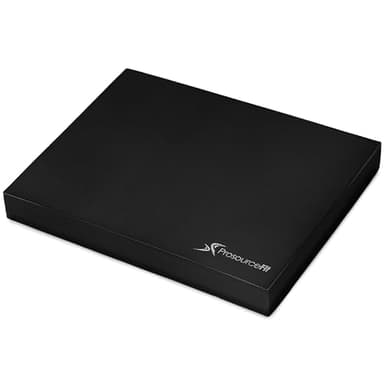
Stand on it on one leg and everything from your foot to your hip has to work. Doubles as a knee pad for floor work, which matters when kneeling isn't comfortable any more. The most-used thing I own.
Check price on Amazon →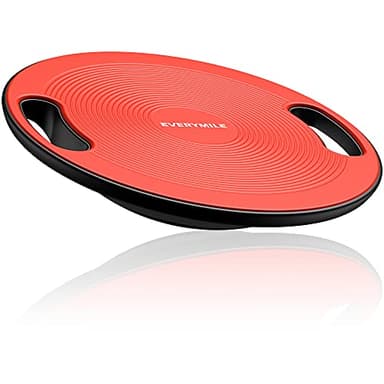
The progression once the pad gets easy. Hold onto something at first. I did, and there's no prize for skipping that step. Two minutes a day does more for hip stability than most of what you'd rather be doing.
Check price on Amazon →The routine, roughly
Stretch daily, morning if you can manage it, any time if you can't. Leg lifts (side, front, back) before you're even out of bed. Balance work. Pull-ups and push-ups, because they strengthen your arms and back and they also strengthen your psyche.
It's simple, but it's not easy. Those are different problems, and only one of them is solved by knowing more.
Next: Nutrition. Exercise is king and diet is queen; together you have a kingdom.
These six pillars are the curriculum for a real program. EVEryday CHAMP runs them as a six-week course for kids aged 7–12: movement, a mindset lesson, a challenge, and a commitment said out loud, every session. Details and cohorts at everydaychamp.com.
Use it as a reason. Not as an excuse.
As an Amazon Associate I earn from qualifying purchases.