 Isaac Hess
September 2026
Legg-Calvé-Perthes Disease: What Happens When That Kid Grows Up
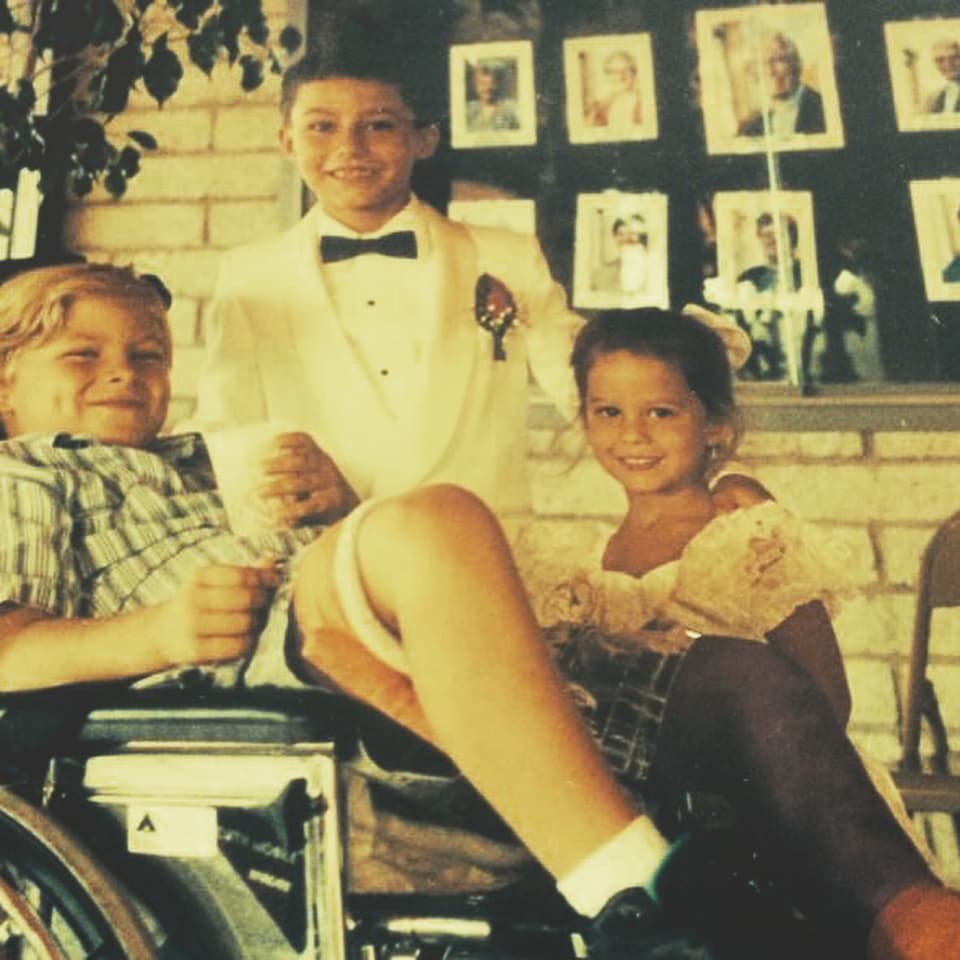
If you're reading this, there's a decent chance you're a parent, it's late, and you typed something like Legg-Calvé-Perthes disease into a search box a few hours after a doctor said it out loud for the first time.
I know what you found. Diagrams of a femoral head. The word avascular. Stage charts. Forums from 2009. A lot of information about the next eighteen months and almost nothing about the next thirty years.
So here is the thing you actually want to know, first, before any of the rest of it.
I had Perthes at seven. I had a total hip replacement at nineteen. Then I pitched seven seasons of professional baseball, and I'm still pitching at forty-one.
That is not a promise about your kid. Nobody can give you that. It's a data point, and right now you are starving for one.
What Perthes actually is, in plain language
I'm not a doctor. What follows is how it was explained to my family by mine, Dr. Richard Shindell in Phoenix, and how I've understood it for thirty-four years of living in this hip.
The head of the femur (the ball of the ball-and-socket) temporarily loses its blood supply. Without circulation, that bone starts to die. The structure softens and can deform while it's soft. Then, over a period of years, the blood supply returns and the body rebuilds the bone.
The whole condition is essentially that: a bone dies and regrows, and the entire question is what shape it's in when it finishes. A femoral head that regrows round enough sits properly in the socket. One that regrows flattened doesn't, and the mismatch is what wears the joint out early.
It's often described in four stages, and I was told it's rare: roughly 1 in 20,000 kids, more often boys, usually somewhere between four and ten years old. Your doctor's numbers are better than mine. Ask them.
Two things I want to say about that description.
The first is that nobody could tell my family what caused it, and as far as I know that's still largely true. My own theory (mine, not medicine) is a badly rolled ankle in a backyard football game when I was four or five. Maybe. You will want a cause. You may not get one, and it is not something you did.
The second is that "disease" is a strange word for it. It isn't contagious, it isn't progressive forever, it doesn't spread. It's an injury to a blood supply with a long, slow recovery. I call it a condition.
The signs my family missed
This is the part I'd put in every parent's hands if I could.
I was a naturally athletic kid. Good at every sport, no complaints, nothing anyone noticed. Then one night when I was seven I got up to go to the bathroom and collapsed in the hallway with what felt like knives running down my whole left leg.
By the time anyone knew anything was wrong, I was late in stage three of four.
That's the cruel design of it. The bone can be dying quietly for a long time before anything hurts enough to say out loud. Looking back, the things that were there to notice:
- A limp that comes and goes, especially late in the day or after activity
- Pain that shows up in the knee or the thigh rather than the hip, which is why it gets missed
- Less range of motion on one side, like a kid who can't rotate one leg out as far as the other
- Stiffness in the morning that loosens up, so it never seems urgent
None of those look like an emergency. That's the problem. If you're seeing them in a child and nobody has X-rayed the hip, ask for that specifically.
Can a kid with Perthes play sports?
This is the question underneath the question, and it's the one I get asked most.
I can't answer it for your child. Perthes is not one condition with one outcome. A four-year-old with a mildly affected head and a nine-year-old with a badly deformed one are in genuinely different situations, and your orthopedist knows which one you're dealing with.
What I can tell you is what I've watched be true.
Restriction during the active phase is not the same as restriction forever. The years when the bone is soft and rebuilding are the years that matter most for the shape it ends up in, and that's a real, temporary constraint your doctors will set. It is not a permanent sentence, and a lot of families hear it as one.
The thing that hurt me most long-term wasn't activity. It was the years I lost strength around the joint. A hip with muscle around it is protected. A hip without it hands every bit of load to the joint surface. Whatever your child can do safely (and your surgeon defines that list, not the internet), doing it is usually better than not.
Swimming and cycling were repeatedly what got recommended to families I've talked to, because they load the joint less. I'd add that whatever a kid will actually keep doing beats the theoretically optimal thing they quit in a month.
Will my child need a hip replacement?
Some do. Many don't. I did, at nineteen.
The honest version is that a femoral head that heals round often carries a person a long way, sometimes their whole life. One that heals badly deformed wears the joint faster, and "faster" can mean a replacement in their thirties or forties rather than their seventies.
I want to be careful here, because this is where parents spiral. A hip replacement is not the failure state. I know it reads like one at 2am. Mine gave me a professional athletic career I would not have had on the joint I was born with. By six months post-surgery I had roughly half again the range of motion I'd had before the operation, because the arthritic joint had been locking up for a decade.
I've written separately about how long a replacement actually lasts and whether nineteen is too young for one. Both were live questions for me and neither had a good answer online at the time.
What Perthes looks like at forty-one
I'm thirty-four years past diagnosis and twenty-one years past replacement.
I throw a hundred pitches in Florida summer heat. I coach kids on a field several days a week. I have a leg-length difference and I've had it my whole life. There are mornings the hip is stiff, and there are years I let the maintenance slip and paid for it in exactly the way you'd expect.
The maintenance is the whole story, and it is boring: range of motion work, yoga, keeping real strength in the glutes and core, and not carrying weight the joint has to absorb every step. Nobody wants that to be the answer. It is anyway.
What I'd tell you if you called me
Three things.
Your kid is watching how you take this. The condition is going to be what it is. What they'll actually carry into adulthood is whether they learned it was a catastrophe or a thing you handle. I got the second version and it's most of why I'm writing this.
Get educated rather than reassured. Understand the stages, understand what your surgeon is watching for, and ask what the plan is at year five, not just this month. Almost all of the conversation happens in the first year. The joint gets decided over a decade.
Find them one example. Not a statistic. A person. The single most useful thing for a kid with a bad hip is meeting someone whose hip was worse and who is fine. I never had that. I built a career partly out of wanting to be it.
I've written the more personal version of this (the night it started, and the advice I'd give parents) in Perthes Disease: Advice for Parents and Kids.
And if you're in it right now, whether that's a Perthes diagnosis, a hip replacement coming, or a kid who's been told what they won't do again, that is exactly what I work on with people. Not as a clinician. As the person who was the kid in that X-ray, and who found out what was still possible.