 Isaac Hess
August 2026
The Summer I Pitched in Mexico
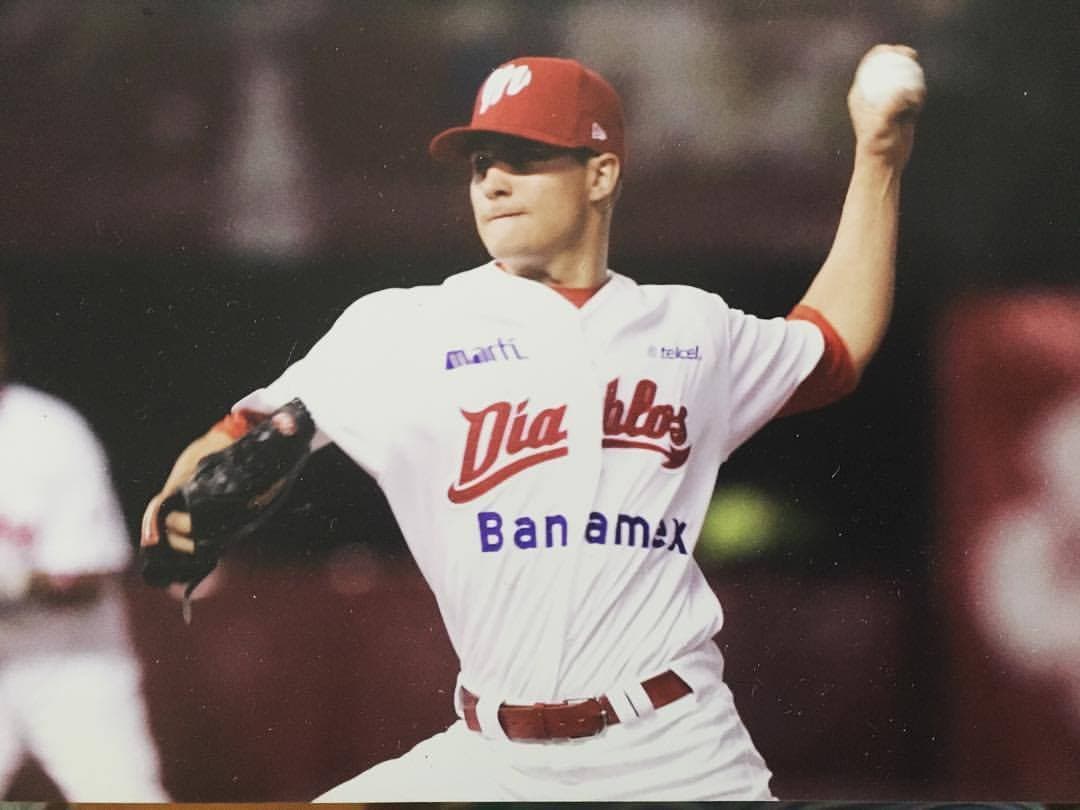
In February 2010 I got an invitation to spring training with the Mexico City Diablos Rojos, the most famous club in Mexican baseball, at the top level of the Liga Mexicana de Béisbol. I was twenty-four and I'd just won a championship with the Calgary Vipers.
I started the season as a starting pitcher. They moved me to the bullpen. Then they traded me to Oaxaca so I could start again.
That's the baseball. I could tell you about the altitude in Mexico City, or the Guerreros, or getting released on 12 June. But I recently found an email I sent to some cousins at three in the morning on 1 June 2010, and it's a truer account of that summer than anything I could reconstruct now.
What I actually wrote
I told them Mexico City was huge and dangerous and Oaxaca was small and safer, and it was nice to be somewhere calmer. I told them I was three and a half months in and learning Spanish as fast as I could (estoy tratando de aprender el idioma muy rápido) and that I still had a long way to go.
I told them I ate a lot of tacos. Which was true, and remains one of the more accurate statements I've ever made about myself.
And then, in the middle of it, this:
I get homesick traveling a lot... and I don't even have a real home! I don't say that negatively in any way, it's just funny when people ask me where home is because I kind of just make something new up every time.
I was twenty-four. Both my parents had been dead for five years. I'd been living out of a truck and a series of clubhouses since I was twenty-one, and I genuinely could not answer the question "where are you from" without picking something.
That summer I was telling people I lived in Hawaii, because I'd stayed with cousins there in the off-season and it was the last place that had felt like a house rather than a stop.
The mirror
Here's the part I'd forgotten until I read it back.
I have pictures of all of you on my mirror in my hotel room. I have pictures up of everyone in my family (that I know of)... even Tracy... and I really don't even know him.
A hotel room in Oaxaca. A twenty-four-year-old taping up photographs of relatives, including one man he had never met, because he was family and that was enough.
I wrote it as a joke. I don't even know him, haha. Reading it sixteen years later I don't think it was a joke at all. I think I was a kid with no parents, in a country where I couldn't yet hold a conversation, building a family out of whatever pictures I could get my hands on and sticking them where I'd see them every morning.
The line right after is: "I miss being around family that is really mine."
"Just stay in the middle"
I also found a piece I wrote that April for JJ Cooper at Baseball America, EVEryday Life in the LMB, and it opens with the only coaching I got in my first week:
"Hess! When you don't know what is going on, just stay in the middle!"
That was my manager, day one. I took it to mean: keep your head on a swivel, watch everything, make friends fast, and don't drift to the edge of anything until you understand it. It turned out to be the whole strategy for the year, on the field and off it.
Mexican baseball was already entertainment baseball
Fourteen years before I coached for the Party Animals, I was playing in a league that had the whole idea figured out.
Between innings at an LMB game I saw live roosters going at each other beside the first-base line. Mascots in a different outfit every couple of frames. Dancers. Acts that no American front office would sign off on.
And underneath all of it, from the first pitch to the last, a conga-style drum being pounded by fans in the stands, with whatever other instruments people had brought. It never stopped. The crowd never sat down.
The talent was serious. The LMB is not a novelty league, and there were guys in it who could pitch anywhere. But nobody there had decided that a baseball game should be quiet.
I didn't know then that I'd end up on a payroll built on exactly that idea.
The question I didn't expect to ask myself
The part of that piece I'm still proudest of is a question I asked partway through the season, and it had nothing to do with me:
Is this what it's like to be a first-year, non-English-speaking Latin player in the US?
A huge share of major league talent comes out of Latin America, and a lot of those players arrive in the States at eighteen. I'd watched it my whole career without thinking about it once.
Then I was the import. I was the guy who couldn't follow the conversation in his own clubhouse, who needed things repeated, who was working out the customs by watching. At twenty-four, with a support system and a plane ticket home if I wanted one.
So I started asking my teammates. The ones who'd played in the States nearly all told me the same thing: two to three years before you feel comfortable in the language and the culture. Two to three years of doing your job at a professional standard while your head is still catching up.
They came out of it bilingual, which they'll have long after they stop playing. But nobody talks about the two or three years.
I'd never have understood that from the other side of it. Getting traded to Oaxaca taught me more about my Latin American teammates than a decade of sharing a dugout with them had.
What Mexico gave me
I got released on 12 June. Diablos Rojos to Oaxaca to released, in about four months, then back to Victoria for the rest of the season, and I was in Arizona by the autumn throwing a bullpen for a Diamondbacks scout who couldn't sign me either.
By any professional measure, 2010 was a bad year.
It's also the year I learned Spanish well enough to keep it, ate at a thousand taquerías, saw two completely different Mexicos, and found out that I could be dropped into a place where I knew nobody and no language and still show up and compete. That has been worth more to me since than the season would have been.
And it's the year I understood something about myself that I couldn't have learned anywhere with a mortgage: I had made "no fixed address" into a personality, and I was lonelier than I was letting on. It took me a long time to admit the second half of that sentence.
Why I'm publishing a private email
Because the version of this story I've told for years is "I pitched in the Mexican League," and that's a line on a résumé.
The real version is a kid at three in the morning telling his cousins he doesn't have a home and that he's put their faces on a mirror. I like him. I want to be careful not to tidy him up.
If you're playing somewhere far from anyone who knows you and you're pretending that's simpler than it is, I'd just say I've been there, and it was the making of me, and it was also lonely, and both of those were true at once.
Eat the tacos. Learn the language. Put the pictures up.