 Isaac Hess
September 2026
The Surgeon Who Wouldn't Tell Me No
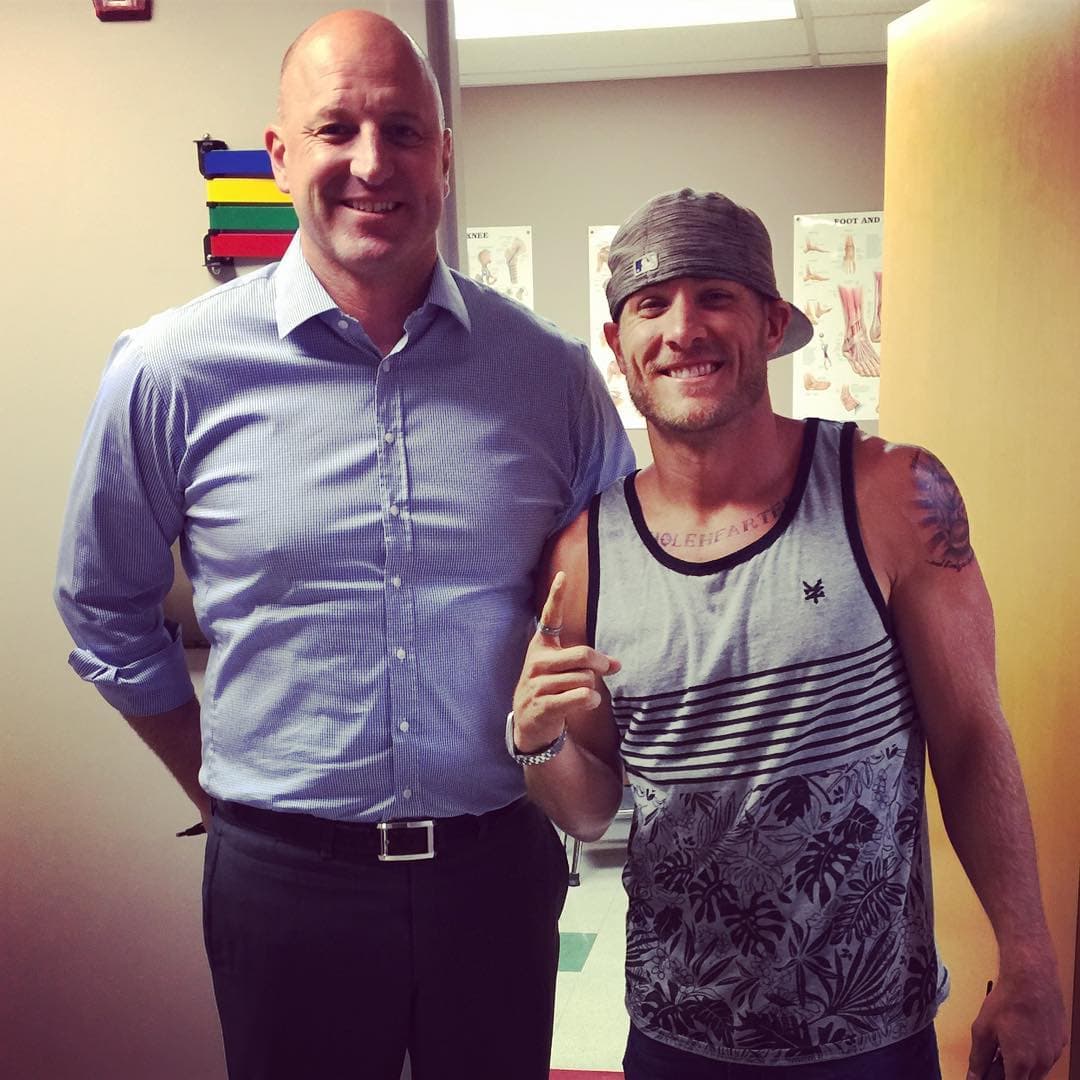
Almost every doctor I have ever sat across from about this hip has been black and white.
Not unkind. Not wrong, exactly. Just certain. You cannot play professional baseball on a hip replacement. Said the way you'd say water is wet: a settled thing, not a question, nothing to discuss on the other side of it.
Two doctors in my whole life didn't talk to me that way. This is about the first one.
It started with my catcher
Kyle Nyhart is one of my best friends from growing up. He caught me. We were the Bash Brothers (that's what people called us and we did nothing to discourage it) and he went on to play at Cameron in Oklahoma.
He's still my friend today. In 2024, when I was with the Party Animals and part of my job was finding a bullpen catcher in every city we rolled into, Kyle caught me again. Twenty-some years later, same guy, same crouch. I don't think I've ever properly registered how strange and good that is.
Back then, Kyle had a shoulder that needed surgery. He got it done by a surgeon in Phoenix named Dr. Michael Wilmink, and he liked him enough to say so.
That's the whole origin of it. My best friend liked his surgeon.
My mom and the second opinion
The other reason I ended up in that office is my mother.
She had a rule about medical things: you get a second opinion. Always. I don't know where it came from and I never thought to ask, and I've been grateful for it my entire adult life. It's the single most useful thing anyone taught me about being a patient.
I was nineteen, home during my first semester at Washington State, and I already knew the thing I wasn't saying out loud to many people: I still wanted to play. Not "wanted." Intended. And if I intended to play, then the question wasn't what happens to me, it was what's the next move.
The next move was a second opinion. So I made the appointment.
What he actually said
Here's what I remember from that room, and I've had twenty-two years to think about it.
He looked at the hip and told me that yes, based on the condition of it, I was a candidate for a total hip replacement, even at nineteen.
He told me the first doctor had been right to recommend putting it off as long as possible. That's real. An implant has a finite life, I was young, and every year I delayed was a year I wasn't spending on the clock.
And then he told me the other half, which nobody had said to me yet: the quality of my life would improve enormously, and that alone made it worth doing now.
He was straight about the rest. It could wear out. I'd have to take care of it. I'd have to keep it strong: not sort-of strong, seriously strong, forever.
I asked him, more than once, in more than one way: Can I come back and play? Has anyone ever come back from this?
He didn't promise me anything. He also didn't close the door.
What he said, in effect, was that the replacement was what would give me a chance to play again, and that he wasn't going to be the one to tell me I couldn't.
Why that was the whole thing
I want to be precise about what made him different, because it isn't that he told me what I wanted to hear.
He gave me the probabilities. He gave me the risks. He gave me the wear-and-tear math and the maintenance requirement and every reason a nineteen-year-old should think hard.
What he didn't do was sort me into the average before I'd had a chance to be an exception.
That's the distinction, and almost nobody gets it right. Telling me the odds is your job and I want you to do it. Deciding on my behalf which side of the odds I land on is not your job, and most doctors did it anyway, usually in the first ninety seconds, usually without noticing.
Something I only learned later makes it land harder. Wilmink has practiced in the valley for over twenty years, and I walked into his office near the very start of that. In 2007 (three years after I sat in his exam room), he was the surgeon who introduced the anterior hip replacement to Arizona.
So the read I had on him at nineteen was right, and I didn't have the evidence for it at the time. He was a man comfortable being ahead of the consensus. I just happened to be a kid who needed exactly that.
What I didn't know
Here's the part I'd change if I could go back, and it's nothing he did.
I walked out of that office thinking the equation was simple. Get the hip fixed. Get strong. Play again.
I had no idea that being healthy and being cleared are two entirely different things. I didn't know a university could decline to clear me. I didn't know a major league organization's decision could come down to insurance liability rather than what I could do on a mound.
Nobody explained that, and honestly I'm not sure it was anyone's job to. But it's the thing I'd tell nineteen-year-old me: the surgery is the easy part of the fight.
The only other one
The second doctor who didn't deal in black and white was Dr. Lee with the Arizona Diamondbacks.
His position was: I'd sign him. One year. I wouldn't put a multi-year deal on this guy.
Most people hear that as a hedge. I heard it as a yes. I'll play in the big leagues one year at a time. That was fine with me. That was always fine with me. One year is not a limitation when the alternative on the table everywhere else was zero.
Two men in twenty-two years were willing to stand in the gray. That's the count.
Gray all the way up
My whole hip replacement story is a gray area. You're not really supposed to do this. It isn't normal for a nineteen-year-old to get a total hip replacement, and it definitely isn't normal to pitch seven professional seasons on one afterward.
There's no clean precedent to point at. No protocol that covers it. Every single part of it, top to bottom, is a judgment call somebody had to be willing to make.
It's gray all the way up and down, however you look at it.
But ultimately it's bright.
Dr. Wilmink is a lot of the reason for that. He gave me the truth and left the door open, and a nineteen-year-old walked through it and got a career on the other side.
Thank you.